
Ontario & Quebec · since 2005
Air Quality Testing in Ontario & Quebec
Certified inspectors, accredited lab results, and a written report you can hand to a contractor, landlord or insurer. Same-week appointments across Ottawa, Montreal and Eastern Ontario.
15,000+ inspections since 2005
Accredited lab analysis
IICRC & InterNACHI certified


IICRC certified (the inspection and restoration standards body) · InterNACHI Indoor Air Quality Inspector and Certified Professional Inspector · IAC2 credentialed · IAQA member company · 20+ years, 15,000+ inspections · Samples analyzed by an independent accredited laboratory, never in house.
Our testing services
Mold testing
Indoor air samples plus an outdoor control, analyzed for spore type and concentration. The outdoor sample is what makes the indoor number mean anything.
Asbestos testing
Sampling of suspect materials in buildings put up before 1990. Vermiculite insulation, old floor tile, pipe wrap, textured ceilings.
Residential testing
One worry with a location attached. A basement, a bathroom, a nursery. Targeted sampling, usually off site in under two hours.
Commercial testing
Offices, clinics, restaurants and schools. Multiple sample points, HVAC involvement, documentation built to be defended.
Odour inspection
A musty smell you can’t place. We find the source rather than guess at it.
All services
Not sure which one you need? Compare everything we test for in one place, or call and describe what you’ve noticed.
How it works
Four steps, start to finish. Most residential visits are one to two hours on site, with lab results back in a few business days.
1. Indoor air samples
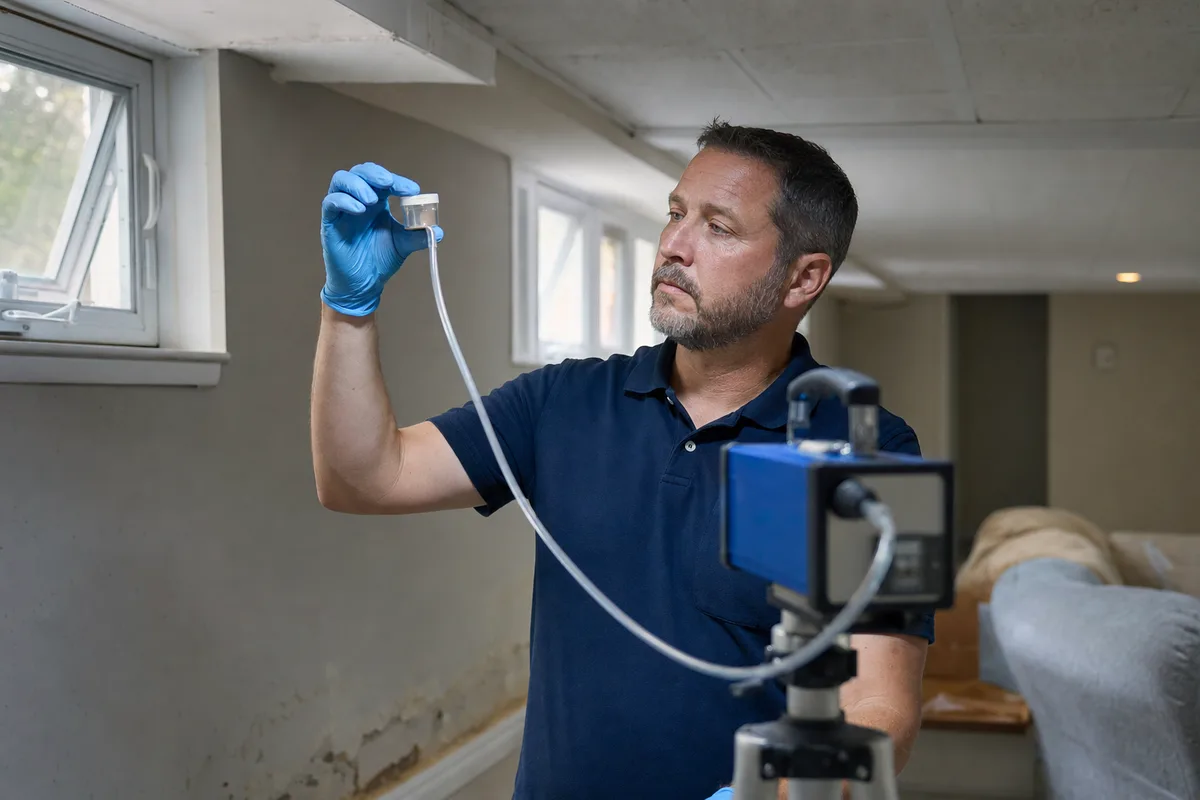
A calibrated pump draws air through spore-trap cassettes in the rooms that matter, alongside a room-by-room visual and moisture check.
2. Outdoor control sample
We take a matching sample outside. Every home has some airborne spores, so the outdoor reading is what your indoor numbers get measured against.
3. Accredited lab analysis
Samples go to an independent accredited laboratory that identifies what is present and at what concentration. We do not read our own results.
4. Written report
You get plain-language findings with the lab data, the moisture readings and a clear answer on whether you need to act. Usually a few business days.

The outdoor control sample is the step cheap testing skips, and without it a lab result is a number with nothing to measure it against. See the full inspection process.
Where we test
Inspectors work out of the Ottawa and Montreal regions, covering Ontario and Quebec.
Ottawa region
Eastern Ontario
Kingston · Brockville · Belleville · Cornwall
Every city we cover is listed on our service areas page. Not sure whether you’re in range? Call and ask. We’d rather tell you no on the phone than have you wait a week to find out.
What it costs
| Service | Typical range | What drives it |
|---|---|---|
| Air quality testing | CAD 300 to 1,500 | Rooms sampled and building size |
| Asbestos testing | CAD 299 to 1,300 | Number of suspect materials |
Nobody can quote you honestly without knowing the size of the space and what you’ve noticed, so we’d rather ask a few questions on the phone than post a flat price and surprise you later. Full breakdowns: air quality testing cost in Canada and asbestos testing cost in Canada.
Learn about indoor air quality
Plain-language guides written by our inspectors. Start with the basics, or jump to the topic you came for.
What is indoor air quality?
The starting point. What IAQ actually measures and why it matters in Canadian homes.
Common indoor air pollutants
What ends up in the air inside a house, and which of it is worth acting on.
Why test your air?
When testing is worth the money and when it honestly isn’t.
How to improve your air
Practical fixes, from ventilation and humidity control to what actually needs a professional.
Understanding your results
Spore counts, the outdoor comparison, and what the numbers on your report mean.
All resources
Every guide in one place.
From our blog
How the air inside a building affects the people in it, plus regional guides for Montreal and Ottawa.
Independent reviews of monitors, kits, sensors and samplers, tested against what we use professionally.
Popular: Best air quality testing kits
Buying, selling, renting or just worried about a smell. Testing advice for residential situations.
Popular: Signs your home needs testing
Offices, restaurants and industrial sites. Compliance, HVAC and staff complaints.
Popular: Air quality regulations in Canada
What testing actually costs across Canada and the factors that move the number up or down.
Popular: Asbestos testing cost in Canada
Testing around a closing date, and what an inspector’s “recommend further testing” note actually means.
Popular: Air quality testing for home buyers
Why people call us
In our experience the musty-basement calls in the Ottawa Valley run seasonal. Spring freshet lifts the water table, foundations weep for a few weeks, and by June somebody’s calling about a smell that’s been building since March. After 15,000 inspections you stop guessing and start recognising.
20+ years in the field
Since 2005 and past 15,000 inspections. When an inspector walks into your basement, they’ve very likely stood in a hundred like it.
Independent lab
Samples go to an accredited laboratory for analysis, so the numbers on your report come from a third party.
A report you can use
Written to be handed to a contractor, landlord, insurer or lawyer. Spore counts, outdoor comparison, photos, plain English.
More about our inspectors and credentials, and how we handle accuracy and corrections in our editorial policy.
Common questions
Yes. It detects airborne spores and identifies which types are present, though it won’t pinpoint which wall the growth is behind. That’s why we pair sampling with a physical inspection. More on testing for mold.
Same-week is normal. Most bookings made Monday are tested by Friday. Post-flood or a closing deadline can usually be fitted in within 24 to 48 hours.
A musty smell that keeps returning, water that sat longer than about 48 hours, a home inspector’s note before a closing, or any renovation in a building put up before 1990. Signs your home needs testing.
For a rough curiosity check, sure. Most consumer kits are settle plates measuring what falls onto a dish rather than what’s suspended in the air, usually with no outdoor comparison, and they won’t satisfy an insurer or a lawyer. We review the kits here.
Lab turnaround is a few business days. We send the written report once results are in and we’ve checked them against what we saw in the building.

Book a test
Call 1-866-528-2897, Monday to Friday, 8:00 AM to 5:00 PM, or send the details through our contact page.
Tell us what you’ve noticed and roughly how big the space is. That’s all we need to say whether testing makes sense. If it doesn’t, we’ll tell you that too.
Last updated: 8 September 2026