
Commercial Air Quality Testing
If you run an office, retail location, school, warehouse, or healthcare facility in Ontario or Quebec, the air your team breathes is a workplace-safety issue, an HVAC issue, and a productivity issue all at once. Commercial air quality testing identifies what’s actually in the air, starting with mold and asbestos, and gives you a defensible written report you can hand to a property manager, an insurer, or an OHS inspector.
Air Quality Testing Canada has been serving commercial clients for 20+ years and 15,000+ inspections. Our IICRC and IAQA-certified inspectors use lab-grade real-time monitors, spore traps, and bioaerosol sampling, and we send every sample to an accredited Canadian laboratory. Same-week scheduling across Ontario and Quebec.
Sick Building Syndrome: 4 Common Causes in Canadian Workplaces
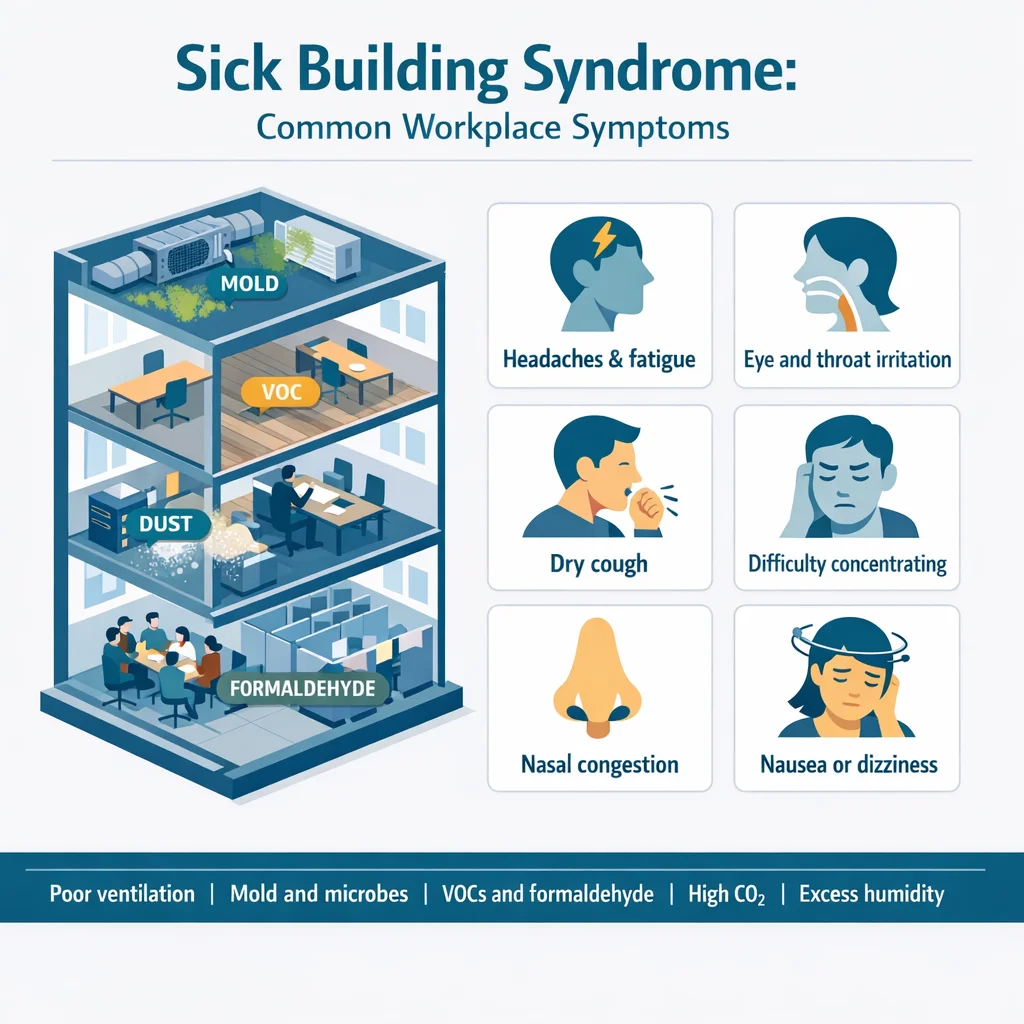
Sick Building Syndrome (SBS) — sometimes called Sick House Syndrome when it shows up in residential buildings — is a cluster of symptoms that workers and visitors experience while inside a specific building, and that improve once they leave. Health Canada and the Canadian Centre for Occupational Health and Safety (CCOHS) recognize four primary causes:
1. Inadequate ventilation — outdoor air exchange below ASHRAE Standard 62.1 levels, often after building retrofits or HVAC failures.
2. Chemical contaminants from indoor sources — VOCs and formaldehyde off-gassing from new furniture, carpeting, paint, cleaning products, or printers.
3. Chemical contaminants from outdoor sources — vehicle exhaust, plumbing vents, or nearby construction drawn in through air intakes.
4. Biological contaminants — mold, bacteria, dust mites, pollen, or virus particles, typically from water damage, humid HVAC components, or stagnant water in drain pans and humidifiers.
The most reported workplace symptoms are headaches, eye and throat irritation, dry cough, difficulty concentrating, nasal congestion, and nausea or dizziness. Sick building syndrome testing is the only reliable way to identify which of these four cause buckets is driving the symptoms in your space — and the data drives a targeted, defensible remediation plan instead of a $50,000 guess.
What We Test for in Commercial Buildings
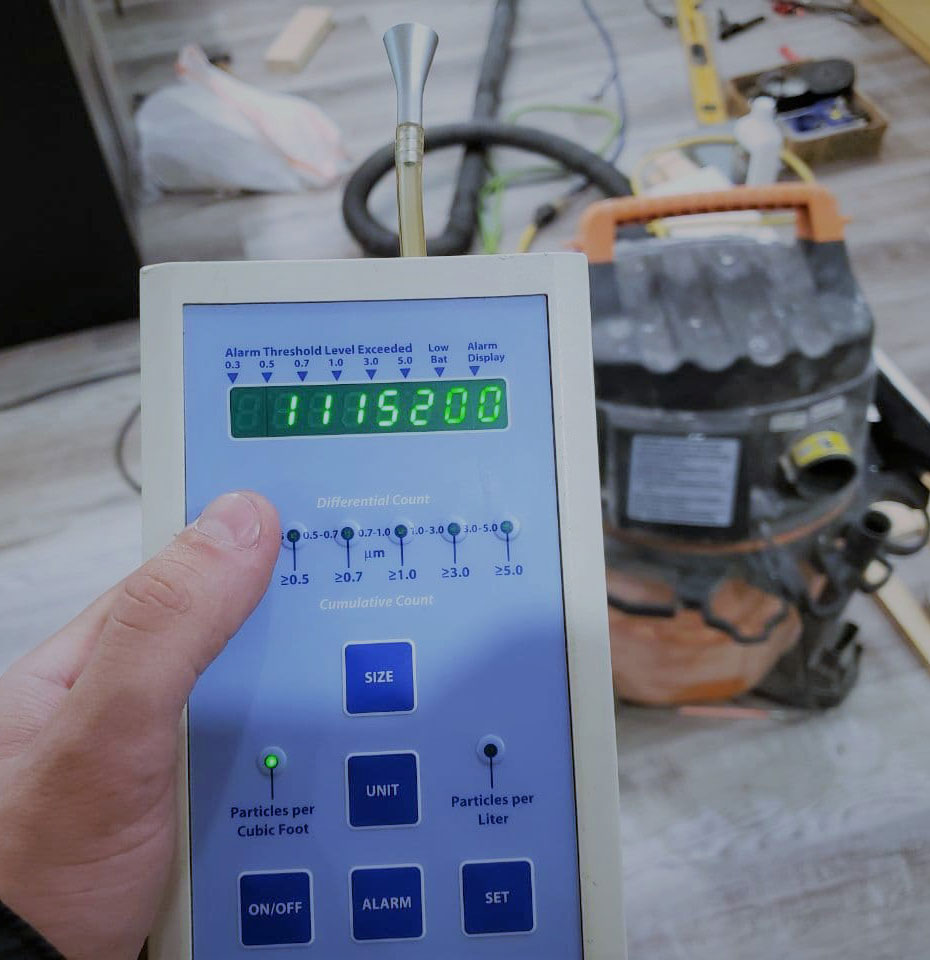
A commercial air quality test is only useful if it covers the contaminants that actually exist in your building. Before that, it helps to know what to expect during an air quality inspection. We test for two contaminant categories, each with the right method, sampler, and accredited lab analysis behind it:
• Mold and bioaerosols — spore-trap and bulk sampling for Stachybotrys (black mold), Aspergillus, Penicillium, Cladosporium, and bacterial colonies. Often triggered by HVAC condensation, roof leaks, or basement humidity. See our dedicated mold testing service for residential cases.
• Asbestos — mandatory before any renovation or demolition in buildings constructed before 1990. Bulk samples of suspect drywall, ceiling tiles, vinyl flooring, pipe insulation, and vermiculite. Required by Ontario Reg. 278/05 and Quebec CNESST regulations. Learn more about our asbestos sampling.
Every sample we collect goes to an accredited Canadian lab. You get a written report with concentrations, the regulatory thresholds they’re measured against, and a clear pass or fail, the kind property managers, insurers, and OHS inspectors actually accept. Our inspectors also note ventilation and moisture conditions during the walkthrough, since those are usually what let a mold problem start in the first place.

Industries We Serve
Different commercial buildings have different air-quality risk profiles. We tailor every commercial air quality test to the way your space is actually used — what the HVAC handles, what materials are off-gassing, and what your people are exposed to:
Office Buildings
HVAC mold, damp ceiling voids after roof or plumbing leaks, and asbestos in pre-1990 fit-outs are the top complaints. We test before and after major renovations.
Warehouses & Manufacturing
Asbestos in older structures, and mold where loading doors, roof leaks, and washdown areas let moisture sit. We sample against Ontario OHS requirements.
Schools & Daycares
Older buildings often have asbestos in flooring and pipe insulation, plus mold in portables and around aging window seals. We deliver reports parents and school boards can act on.
Healthcare Facilities
Clinics, dental offices, and senior care need bioaerosol and clearance testing tied to infection-control protocols.
Retail & Restaurants
Cooking emissions, refrigerant leaks, mold behind dish-pit walls, and HVAC complaints from staff or customers.
Multi-Residential & Hotels
Suite-to-suite mold and odour transfer, parking-garage CO migration, and humidity issues during shoulder seasons.
How commercial air quality testing works
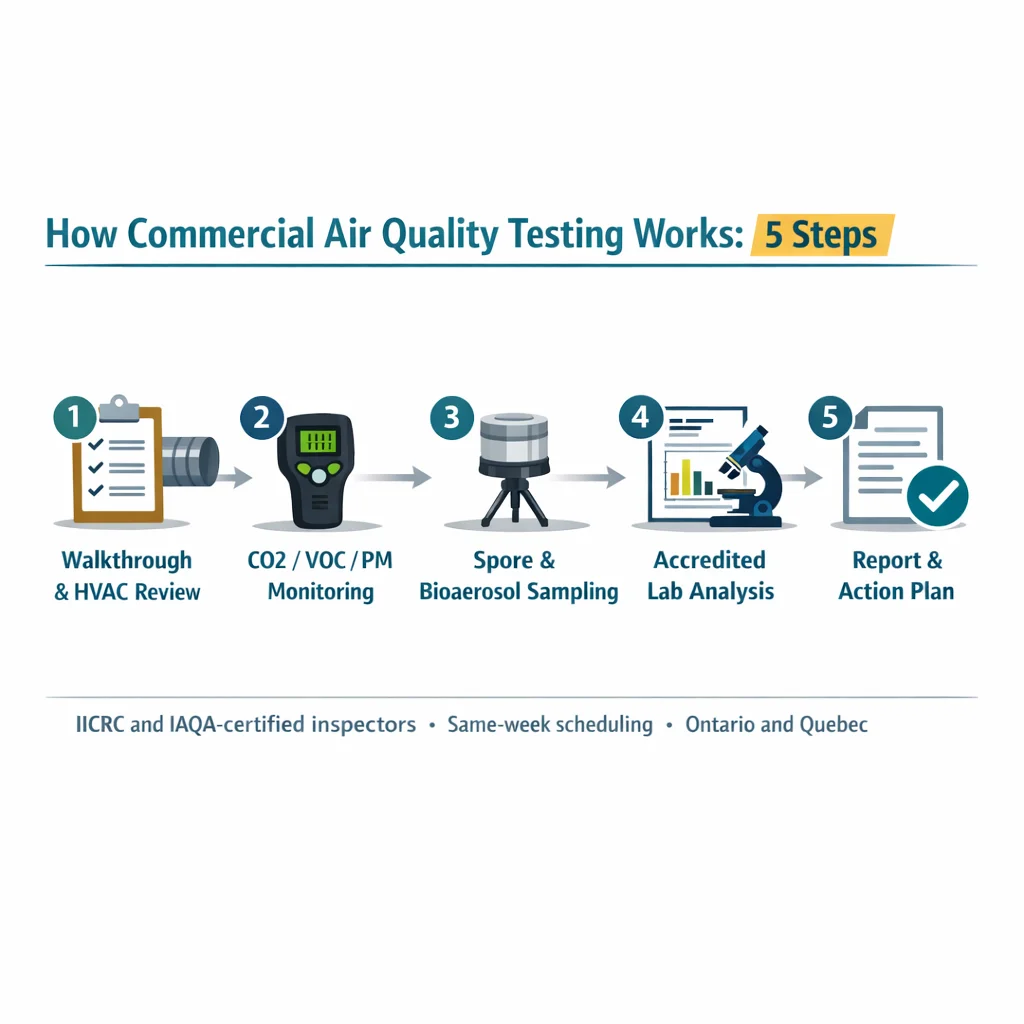
A commercial air quality test is a 5-step, evidence-based process — not a single sensor reading. Here’s exactly what we do on every project:
1. Walkthrough and HVAC review. Our IICRC-certified inspector walks the building with your facility lead, flags visible moisture, ventilation, and material issues, and reviews HVAC service records.
2. Moisture mapping and ventilation review. We take moisture, humidity and temperature readings across multiple zones under normal occupancy, not after-hours when the numbers don’t reflect reality. That tells us where mold is most likely to be growing and where the samplers need to go.
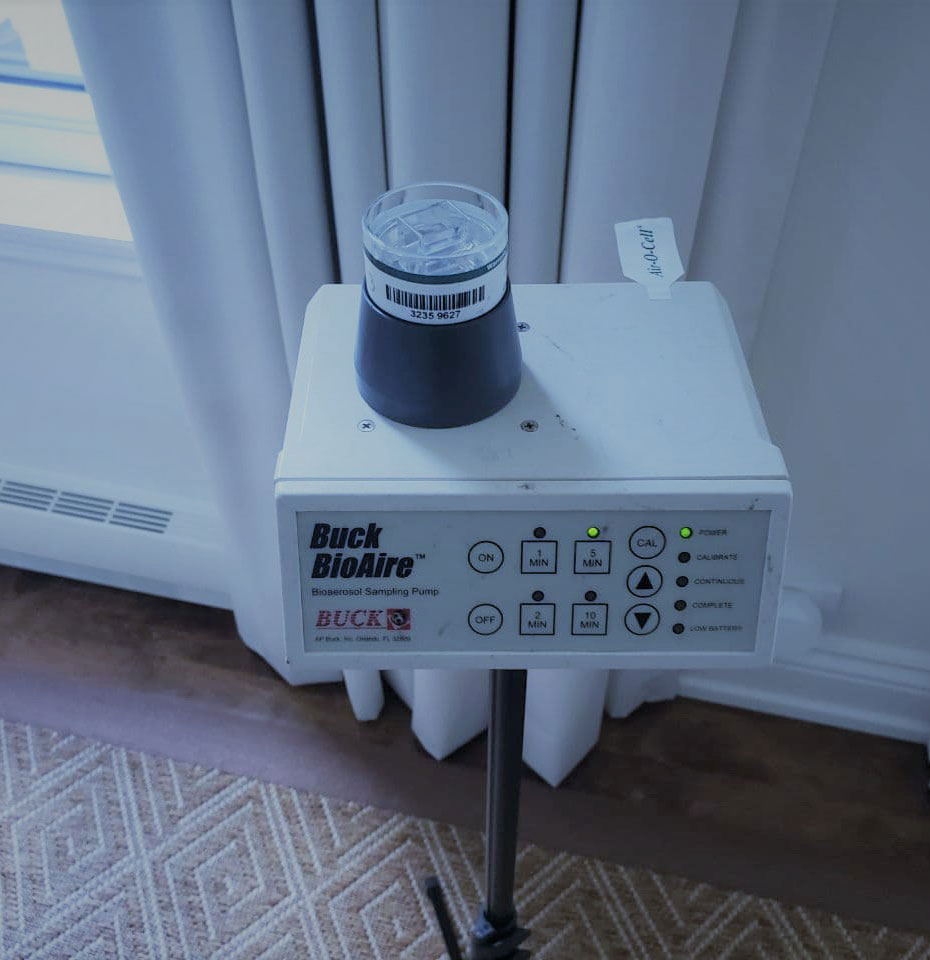
3. Spore traps and bioaerosol sampling. Where mold or bacteria are suspected, we collect timed air-cassette samples and surface swabs, plus an outdoor control sample for comparison.
4. Accredited Canadian lab analysis. Every sample is processed by an ISO/IEC 17025 accredited lab with chain-of-custody documentation — the same standard insurers and litigators require.
5. Written report and action plan. Within 5 business days, you receive a report with measured concentrations, regulatory thresholds (Health Canada, ASHRAE, CCOHS, OSHA), pass/fail by category, and a prioritized remediation plan. Need professional mold removal afterwards? We work alongside trusted IICRC-certified remediation partners.
What Commercial Clients Say
Real feedback from recent commercial inspections across Ontario and Quebec
"Two of our staff started complaining about headaches and that 'something smelled off' in the boardroom. The inspector found mold growth behind the HVAC return — caught it before our lease renewal walkthrough. Defensible report I could hand to the landlord."
"We needed asbestos clearance before rebuilding the mezzanine in our older warehouse. They came in, pulled bulk samples the same week, and gave us a written compliance summary in five business days. Insurer accepted it without follow-up."
"Three line cooks were getting headaches every shift. They sampled behind the dish-pit wall and found grease-trap mold and a cracked makeup-air return. Numbers I could share with my insurer. Problem solved before health inspection."
"We were renovating a 1960s wing of the school. Asbestos clearance was non-negotiable — parents wanted to see actual lab results. Their report was so clear we presented it at the next board meeting. No questions, no callbacks. Will use again for the next phase."
Office Mold Testing: Signs Your Workplace Has a Problem
Office indoor air quality testing for mold follows the same scientific protocols as residential mold testing — but the stakes and signals are different. The most common workplace red flags are:
• Recurring “musty” smell in conference rooms or near HVAC returns (worth an odour inspection if you cannot find the source)
• Two or more employees in the same zone reporting headaches, congestion, or coughing
• Visible water staining on ceiling tiles, drywall, or window frames
• Recent roof leaks, plumbing failures, or HVAC condensation issues
• Higher absenteeism or sick-day clusters tied to a specific floor or wing
Office air quality testing for mold typically combines an outdoor control sample, 2–4 indoor spore-trap cassettes, and surface swabs of any visible growth. Results are compared to outdoor baselines and indoor-vs-outdoor genus ratios — not to absolute “safe levels” (those don’t exist for mold in Canada). The deliverable is a defensible report with a clear remediation scope, which is what your insurer, board, or landlord will ask for next. Need cleanup afterwards? Our team coordinates with IICRC-certified mold remediation specialists across Ontario and Quebec.
Commercial Air Quality Testing Cost in Canada
Commercial air quality testing in Canada typically ranges from $300 to $1,500 per visit, depending on the size of the space, the number of contaminant categories tested, and how many lab samples the building requires. A small single-floor office with one mold concern usually lands in the $300–$500 range. A multi-floor commercial property needing both mold and asbestos sampling across several zones usually runs $900 to $1,500.
Three things move the price:
1. Number of zones tested. Each spore-trap cassette and each lab sample is a separate analysis fee.
2. Whether asbestos sampling is included. Pre-1990 buildings with suspect materials often need 5–15 bulk samples to comply with Ontario Reg. 278/05.
3. Whether the building needs sampling across multiple shifts rather than a single visit.
We give every commercial client a fixed fee in writing before any sampling begins — no surprises, no per-sample upcharges hidden until the lab invoice arrives. Our published guidance is reviewed by certified inspectors before it goes live. See our editorial policy for how we research, review and correct it.
Frequently Asked Questions
Schedule Commercial Air Quality Testing
IICRC-certified inspectors. Lab-grade reports. Same-week service across Ontario and Quebec.
Mon–Fri 8 AM–3 PM · Response within 1 business day · Flat-rate quotes, no surprises
Our certifications